


raygeo.image.preprocess
Functions
compute_adaptive_threshold()
compute_adaptive_threshold(areas: list[int]) -> int
Compute an adaptive area threshold to separate noise from content.
Analyses the distribution of connected component areas and finds the largest gap to determine a threshold that separates noise (small components) from meaningful content.
| Parameter | Type | Description |
|---|---|---|
areas | list[int] | Sorted list of component pixel areas. |
| Returns | int | Adaptive threshold value (minimum area to keep). |
| Complexity | O(n) where n = number of unique area values |
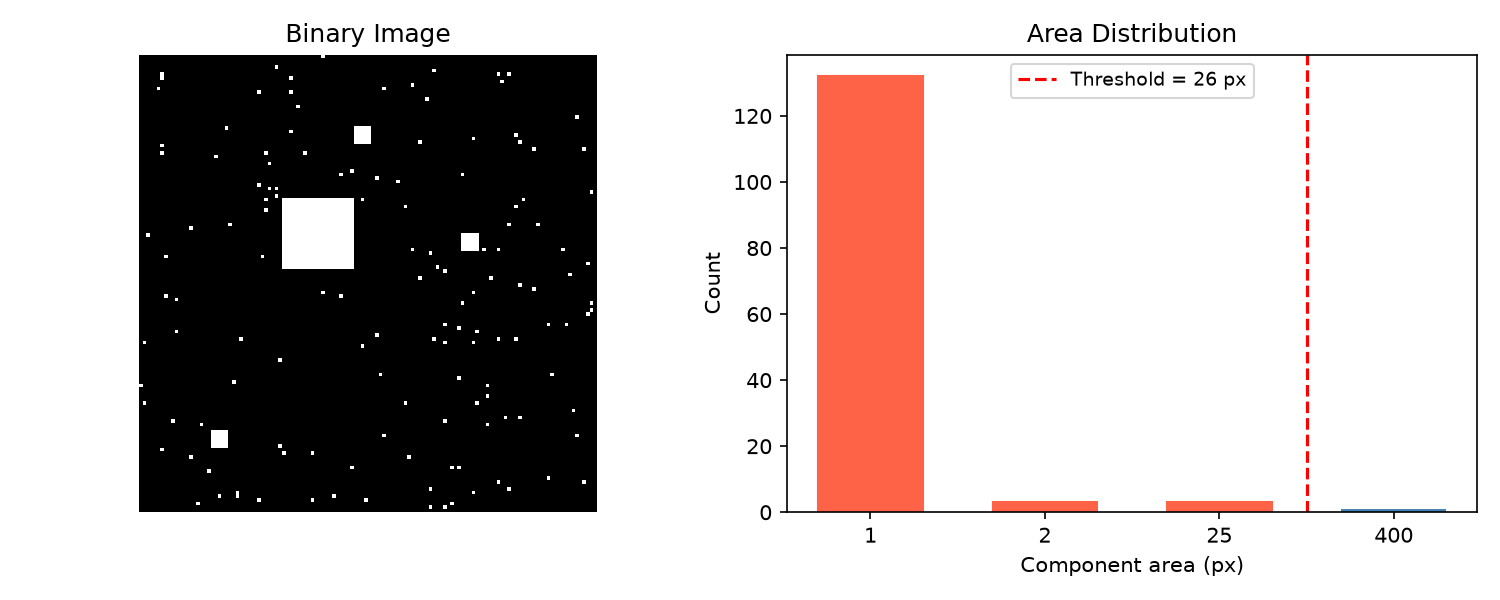
Adaptive threshold from component area distribution
denoise_binary()
denoise_binary(
    binary: numpy.NDArray[numpy.uint8],
) -> numpy.NDArray[numpy.uint8]
Remove small noise components from a binary image using adaptive thresholding.
Computes connected components, finds the largest gap in component area distribution to separate noise from content, and removes small components.
| Parameter | Type | Description |
|---|---|---|
binary | numpy.NDArray[numpy.uint8] | 2D binary uint8 array (values 0 or 1). |
| Returns | numpy.NDArray[numpy.uint8] | 2D binary uint8 array with noise removed. |
| Complexity | O(w*h) |
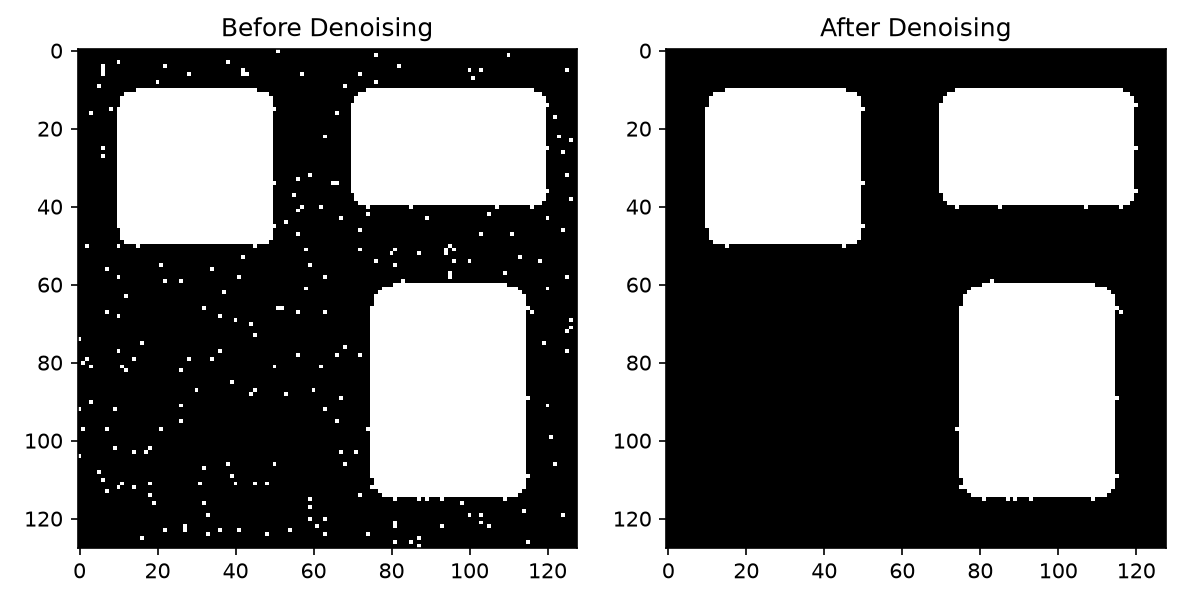
Binary image denoised via adaptive thresholding
filter_components()
filter_components(
    binary: numpy.NDArray[numpy.uint8],
    min_area: int,
) -> numpy.NDArray[numpy.uint8]
Remove connected components smaller than min_area.
Uses 8-connectivity for component detection.
| Parameter | Type | Description |
|---|---|---|
binary | numpy.NDArray[numpy.uint8] | 2D binary uint8 array (values 0 or 1). |
min_area | int | Minimum pixel count to keep a component. |
| Returns | numpy.NDArray[numpy.uint8] | 2D binary uint8 array (values 0 or 1). |
| Complexity | O(w*h) |
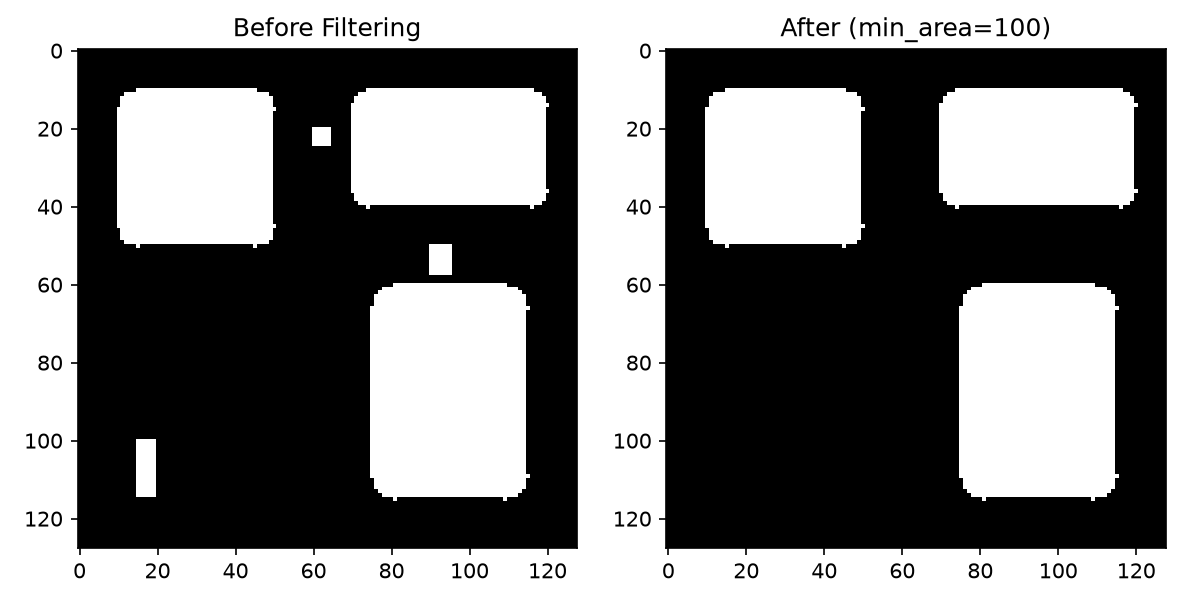
Component filtering by minimum area
get_component_areas()
get_component_areas(binary: numpy.NDArray[numpy.uint8]) -> list[int]
Compute the pixel area of each connected component.
Uses 8-connectivity. Areas are returned sorted ascending. Background (0-valued pixels) is excluded.
| Parameter | Type | Description |
|---|---|---|
binary | numpy.NDArray[numpy.uint8] | 2D binary uint8 array (values 0 or 1). |
| Returns | list[int] | Sorted list of component pixel areas. |
| Complexity | O(w*h) |
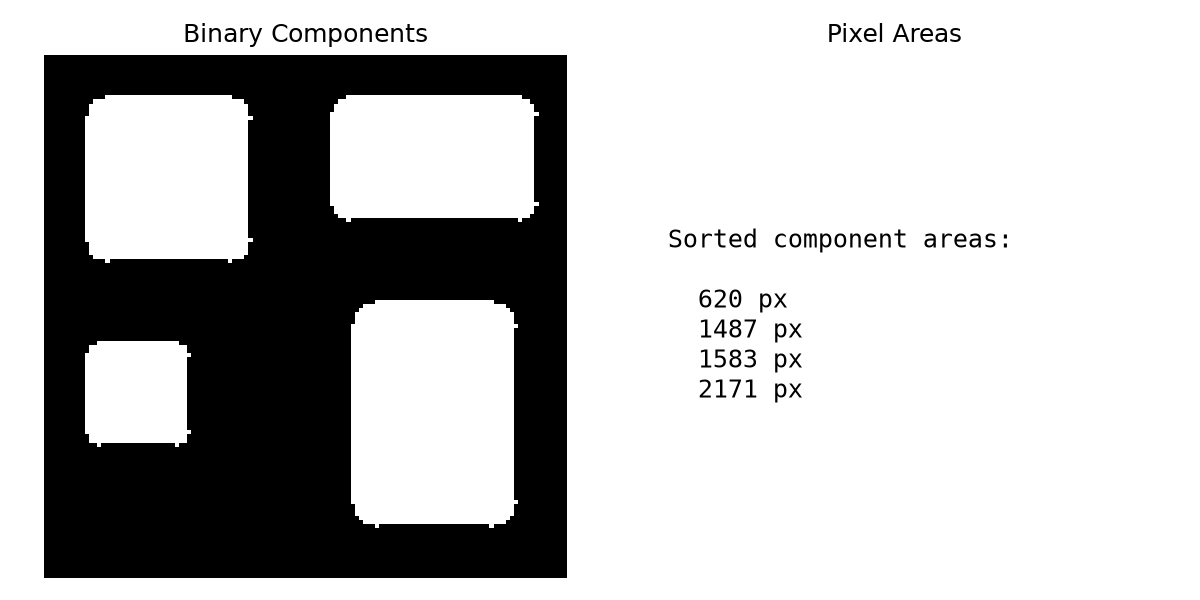
Connected component areas sorted ascending
grayscale_to_binary()
grayscale_to_binary(
    gray: numpy.NDArray[numpy.uint8],
    threshold: float = 0.5,
    invert: bool = False,
    auto_threshold: bool = True,
) -> numpy.NDArray[numpy.uint8]
Convert grayscale image to binary using Otsu or fixed threshold.
Pixels at or below the threshold become foreground (1). Uses Otsu's method when auto_threshold is True.
| Parameter | Type | Description |
|---|---|---|
gray | numpy.NDArray[numpy.uint8] | 2D grayscale uint8 image. |
threshold | float = 0.5 | Fixed threshold (0.0-1.0), used only if auto_threshold is False. |
invert | bool = False | If True, pixels above threshold become foreground. |
auto_threshold | bool = True | If True, compute threshold via Otsu's method. |
| Returns | numpy.NDArray[numpy.uint8] | 2D binary uint8 array (values 0 or 1). |
| Complexity | O(w*h) |
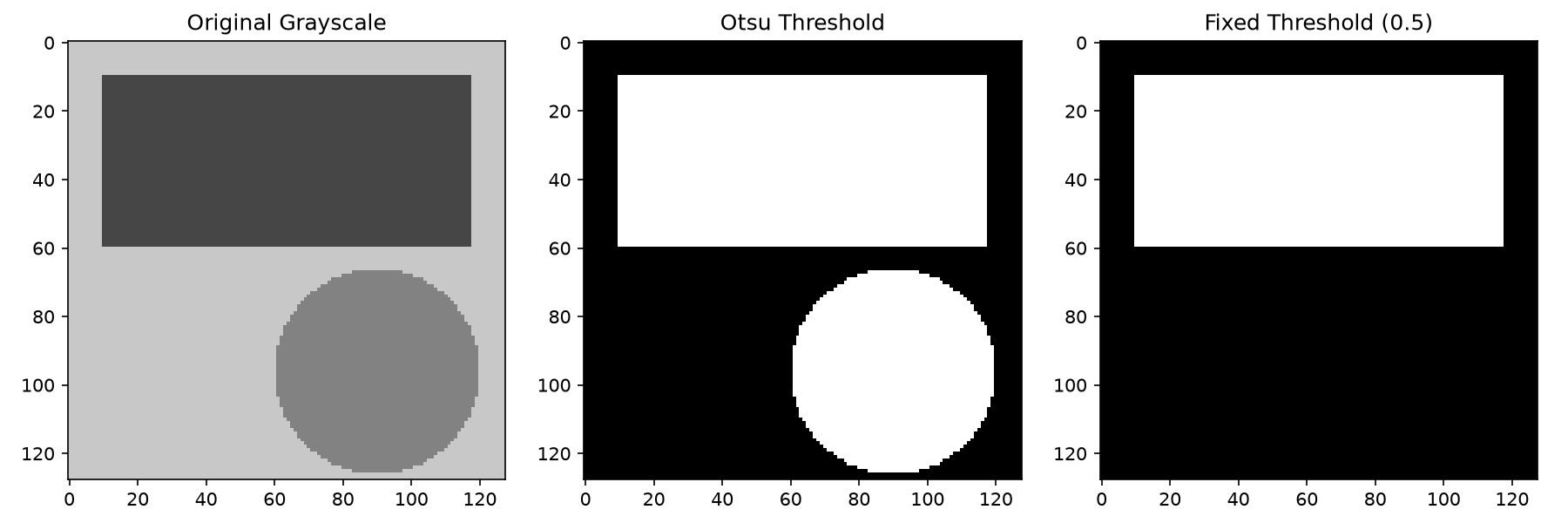
Grayscale to binary via Otsu and fixed threshold