


raygeo.ops.cut.stepper
StepResult
Result of a single forward step.
Contains the next centre position, updated heading, solver iteration count, and the final status.
cut_area
cut_area: float
The incremental cut area (crescent) for this step.
heading
heading: float
Updated heading angle in radians.
iteration_angle
iteration_angle: float
Solver steering angle (radians). Only non-zero for step.
iters
iters: int
Number of solver iterations used.
next
next: tuple[float, float]
Next centre position (x, y).
status
status: StepStatus
Step completion status.
StepStatus
Status of a single step or cut segment.
One of Ok (normal), BoundaryHit (hit pocket boundary), LostEngagement (no uncut material), or
NoConvergence (solver failed to converge).
boundary_hit()
@classmethod boundary_hit() -> StepStatus
Hit pocket boundary.
| Parameter | Type | Description |
|---|---|---|
| Returns | StepStatus | StepStatus.boundary_hit |
lost_engagement()
@classmethod lost_engagement() -> StepStatus
No uncut material found.
| Parameter | Type | Description |
|---|---|---|
| Returns | StepStatus | StepStatus.lost_engagement |
no_convergence()
@classmethod no_convergence() -> StepStatus
Solver failed to converge.
| Parameter | Type | Description |
|---|---|---|
| Returns | StepStatus | StepStatus.no_convergence |
ok()
@classmethod ok() -> StepStatus
Normal step completion.
| Parameter | Type | Description |
|---|---|---|
| Returns | StepStatus | StepStatus.ok |
StepperOptions
Configuration options for step.
Holds the constant parameters for the adaptive stepper.
angle_max
angle_max: float
Maximum trial deflection angle in radians.
angle_min
angle_min: float
Minimum trial deflection angle in radians.
dir_sign
dir_sign: float
Directional bias sign: +1.0 for CW, -1.0 for CCW, 0.0 for no bias.
max_deflection
max_deflection: float
Maximum steering deflection in radians.
radius
radius: float
Disk radius in mm.
step_length
step_length: float
Forward step length in mm.
target_area_pd
target_area_pd: float
Target cut-area per unit distance.
valid_area
valid_area: list[list[tuple[float, float]]]
Valid tool-centre region polygons.
Functions
step()
step(
    cleared: cleared_area.ClearedArea,
    pos: tuple[float, float],
    heading: float,
    predicted_angle: float,
    opts: StepperOptions,
) -> StepResult
Perform one forward step using the area-based adaptive solver.
| Parameter | Type | Description |
|---|---|---|
cleared | cleared_area.ClearedArea | ClearedArea instance. |
pos | tuple[float, float] | Current centre position (x, y). |
heading | float | Smoothed heading angle (radians). |
predicted_angle | float | Predicted steering angle from history. |
opts | StepperOptions | StepperOptions instance with fixed parameters. |
| Returns | StepResult | StepResult with the next position and updated heading. |
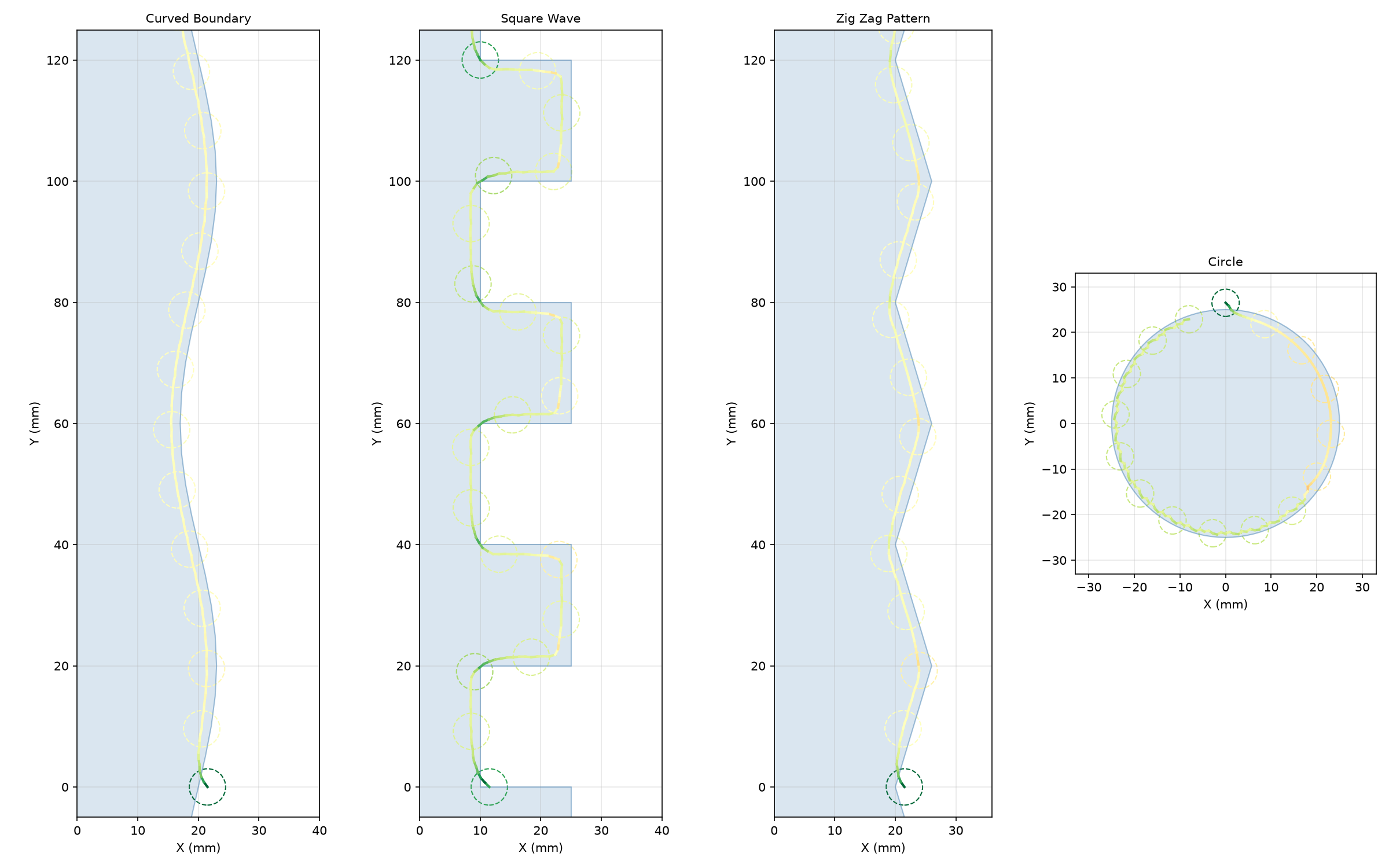
Wall following along four boundary shapes: curved, square wave, zig zag, and circle.
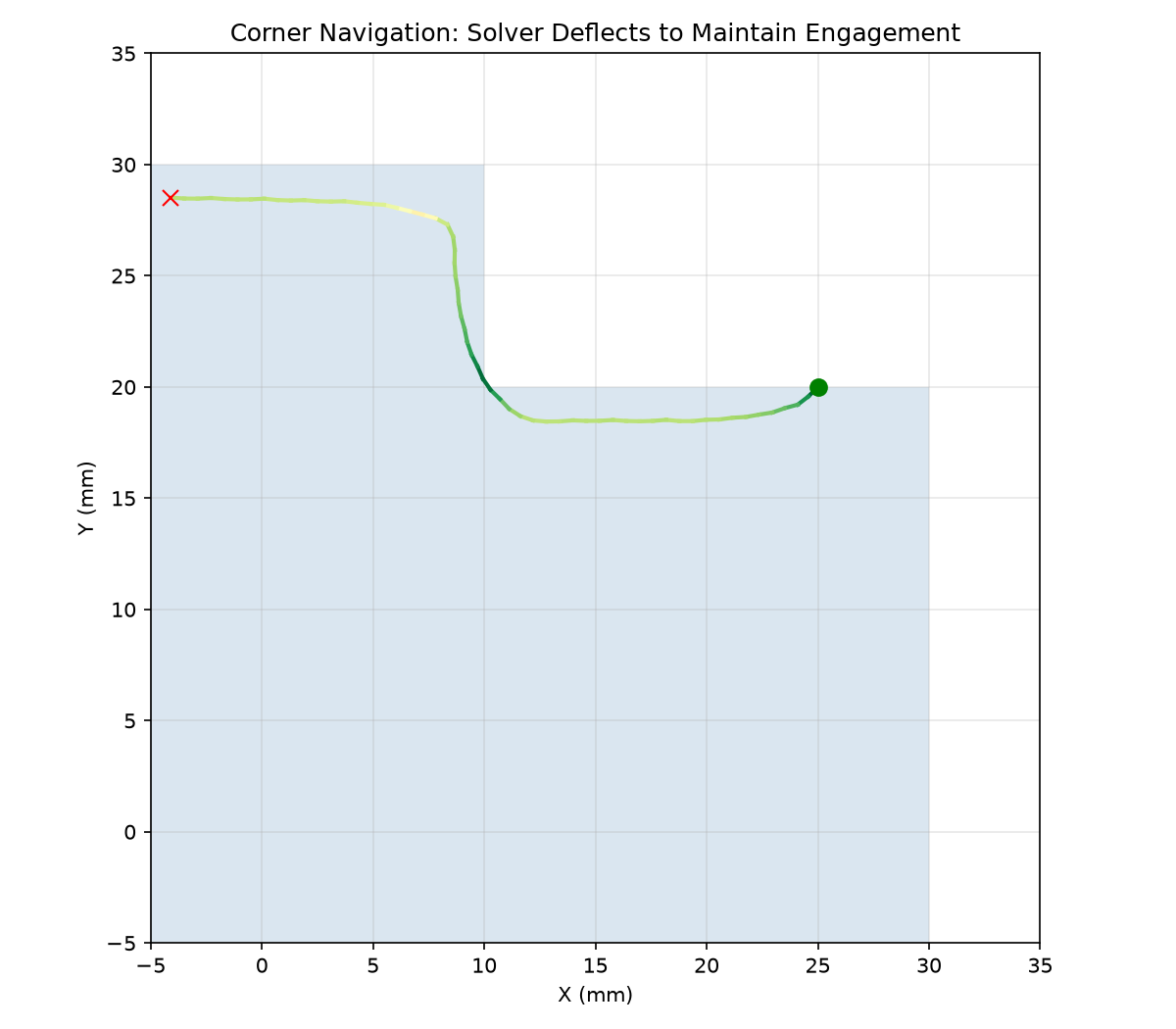
90° corner: the solver deflects the heading to keep engagement constant around the turn.
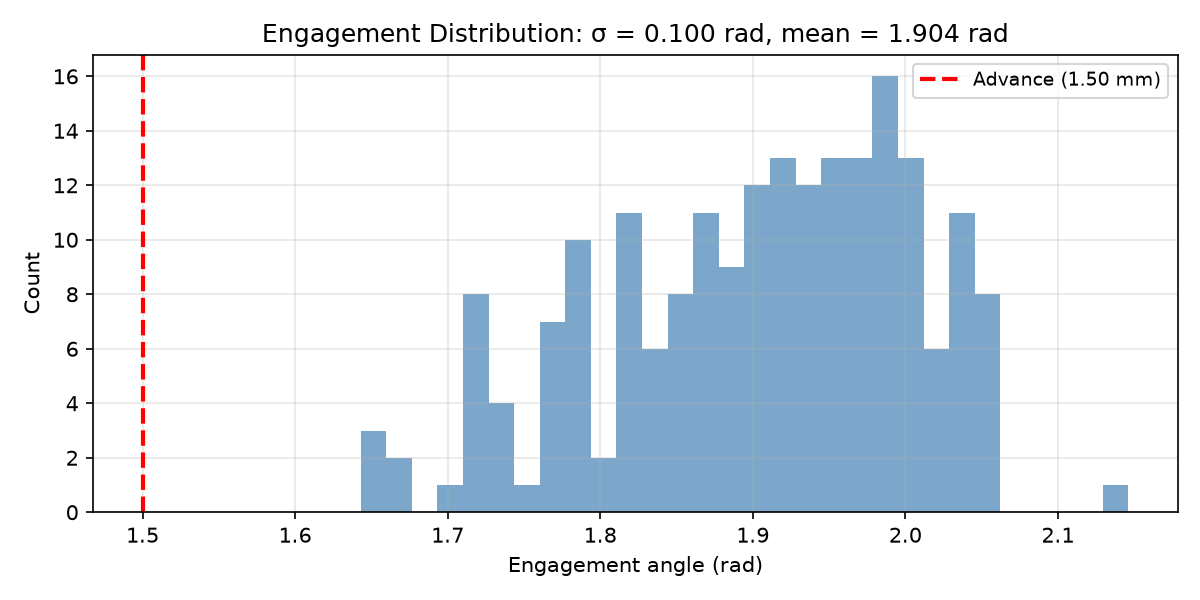
Engagement histogram on a straight wall. Tight peak near target shows stable behaviour.