


raygeo.ops.assembly.adaptive
AdaptiveClearingSpec
Parameters for the adaptive-clearing assembler.
area_tolerance
area_tolerance: float
cut_direction
cut_direction: str
"cw" or "ccw".
expansion_batch_size
expansion_batch_size: int
max_deflection_deg
max_deflection_deg: float
safe_z
safe_z: float
start_heading
start_heading: Optional[float]
start_pos
start_pos: Optional[tuple[float, float]]
Optional override start (x, y).
step_length
step_length: float
step_over
step_over: float
target_z
target_z: float
tolerance
tolerance: float
tool_radius
tool_radius: float
trace_path
trace_path: Optional[str]
Optional path to write a binary trace file.
wall_margin
wall_margin: float
ResumePointNotFoundError
Raised when all resume strategies fail to find an engagement point.
RoutingError
Raised when all route strategies fail to find a path.
Functions
adaptive_clearing()
adaptive_clearing(
    part: ops.part.Part,
    tool_radius: float = 3,
    step_over: float = 1.5,
    step_length: float = 0.6,
    target_z: float = -5,
    safe_z: float = 2,
    max_deflection_deg: float = 30,
    wall_margin: float = 0,
    area_tolerance: float = 1,
    cut_feed_rate: int = 1200,
    cut_power: float = 1,
    start_pos: tuple[float, float] | None = None,
    start_heading: float | None = None,
    expansion_batch_size: int = 20,
    profile: bool = False,
    cut_direction: str = 'ccw',
    trace_path: str | None = None,
    on_progress: Callable[[dict], None] | None = None,
    batch_size: int = 128,
) -> ops.assembly.AssemblyResult
Run forward-stepping adaptive clearing.
Starting from the pre-populated cleared area inside part, uses a constant-engagement stepping solver to generate a continuous spiral toolpath from the seed clearing to the pocket wall.
The caller is responsible for populating the part's cleared area with the entry polygons before calling this method, and prepending the entry Ops to the result.
| Parameter | Type | Description |
|---|---|---|
part | ops.part.Part | The part whose cleared field tracks accumulated workpiece state and whose geometry defines the pocket boundary and islands. |
tool_radius | float = 3 | Tool radius in mm (default 3.0). |
step_over | float = 1.5 | Step-over distance (default 1.5). |
step_length | float = 0.6 | Forward step length in mm (default 0.6). |
target_z | float = -5 | Cutting Z height (default -5.0). |
safe_z | float = 2 | Retract Z height for travel (default 2.0). |
max_deflection_deg | float = 30 | Maximum steering deflection per step in degrees (default 30). |
wall_margin | float = 0 | Extra clearance between tool and boundary (default 0.0). |
area_tolerance | float = 1 | Stop when remaining uncut area drops below this threshold (default 1.0). |
cut_feed_rate | int = 1200 | Feed rate for cutting moves (default 1200). |
cut_power | float = 1 | Laser power for cutting moves (0.0-1.0, default 1.0). |
start_pos | tuple[float, float] | None = None | Initial tool position (x, y). When None, auto-detected from the cleared-area frontier. |
start_heading | float | None = None | Initial tool heading in radians. When None, auto-detected as the CCW tangent at start_pos. |
expansion_batch_size | int = 20 | Batch cleared-area expansions every N steps (default 20). Larger values improve performance but may slightly reduce path quality. |
profile | bool = False | Print a profiling report to stdout (default False). |
cut_direction | str = 'ccw' | Rotational direction of all cutting moves. "cw" or "ccw" (default "ccw"). |
trace_path | str | None = None | When set, write a per-step binary trace file for the Python inspector (debug builds only). |
on_progress | Callable[[dict], None] | None = None | Optional callback receiving progress dicts. |
batch_size | int = 128 | Ops batch size for on_progress (default 128). |
| Returns | ops.assembly.AssemblyResult | Ops with cutting commands (entry not included). |
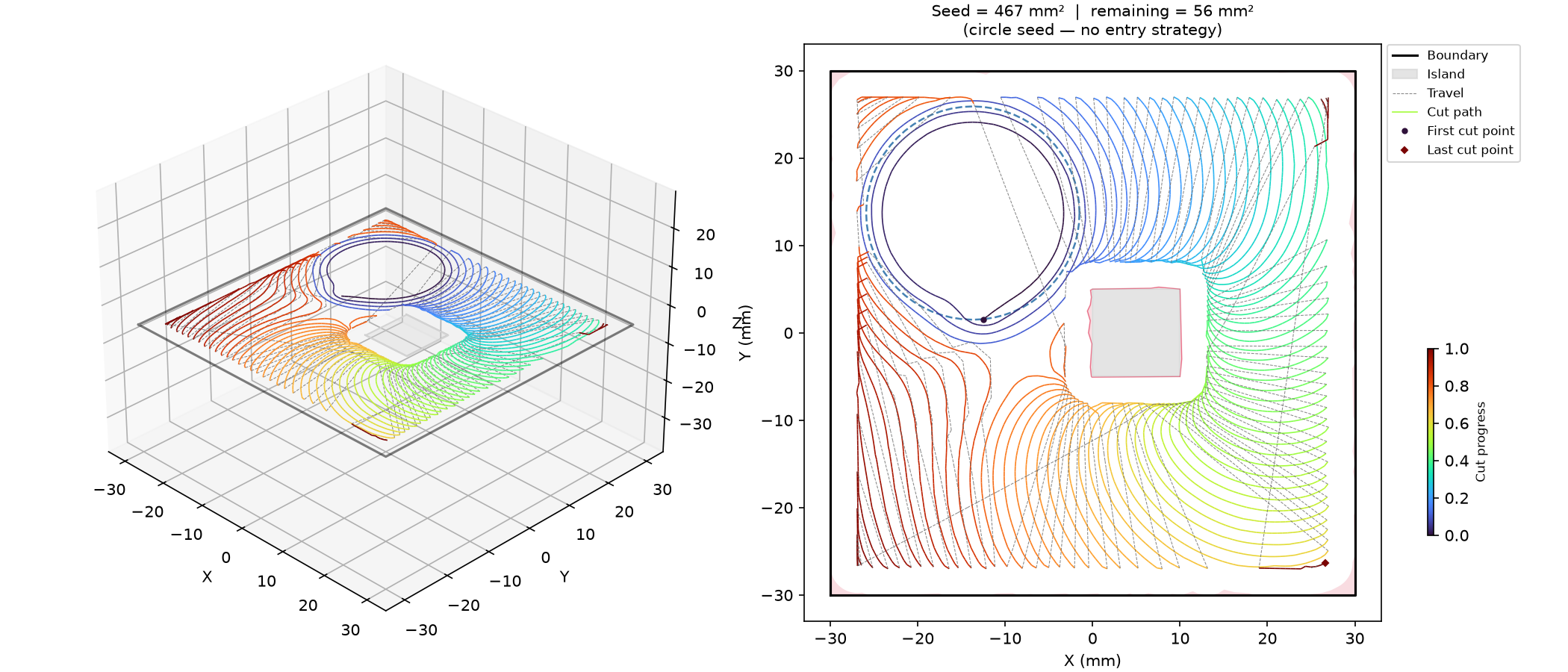
Circle-seed clearing in a square pocket with central island: seed, toolpath, and remaining.
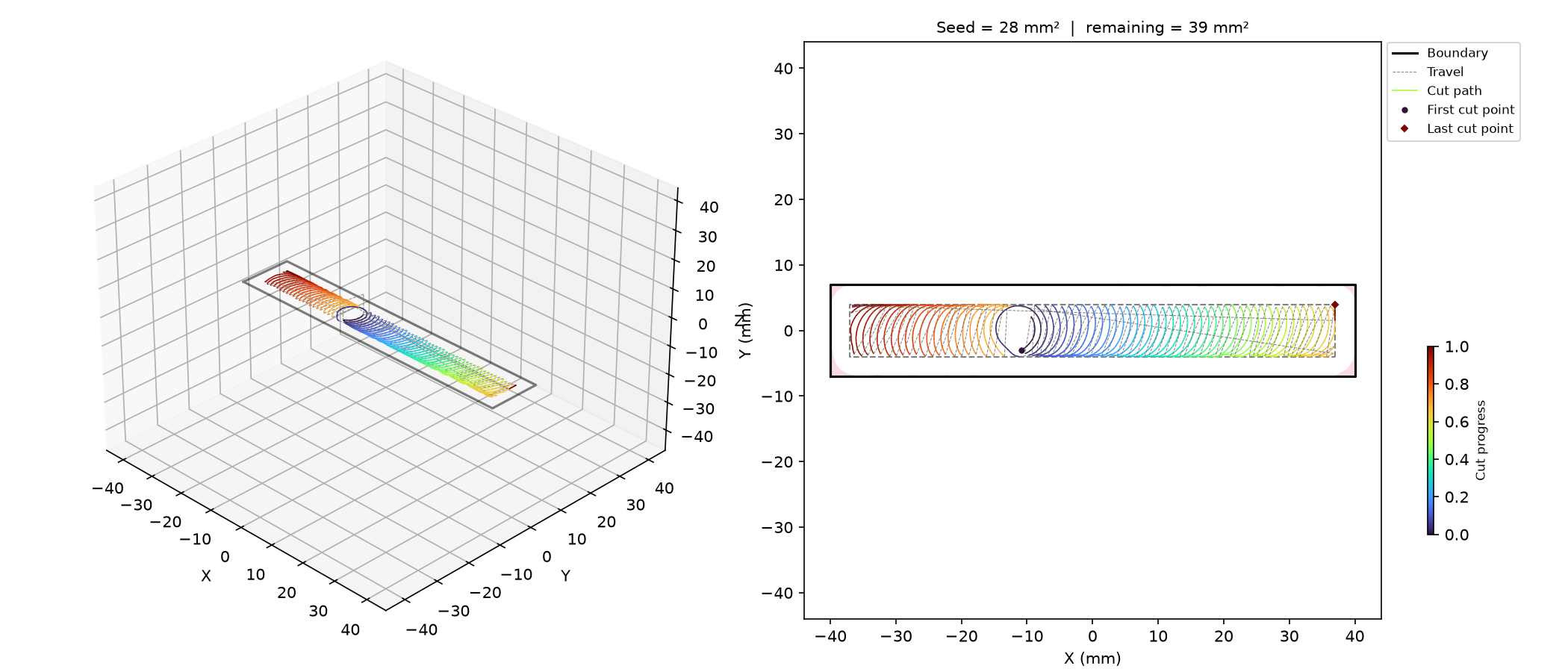
Narrow pocket — 3D toolpath view (left) and 2D top-down with seed/remaining overlay (right).
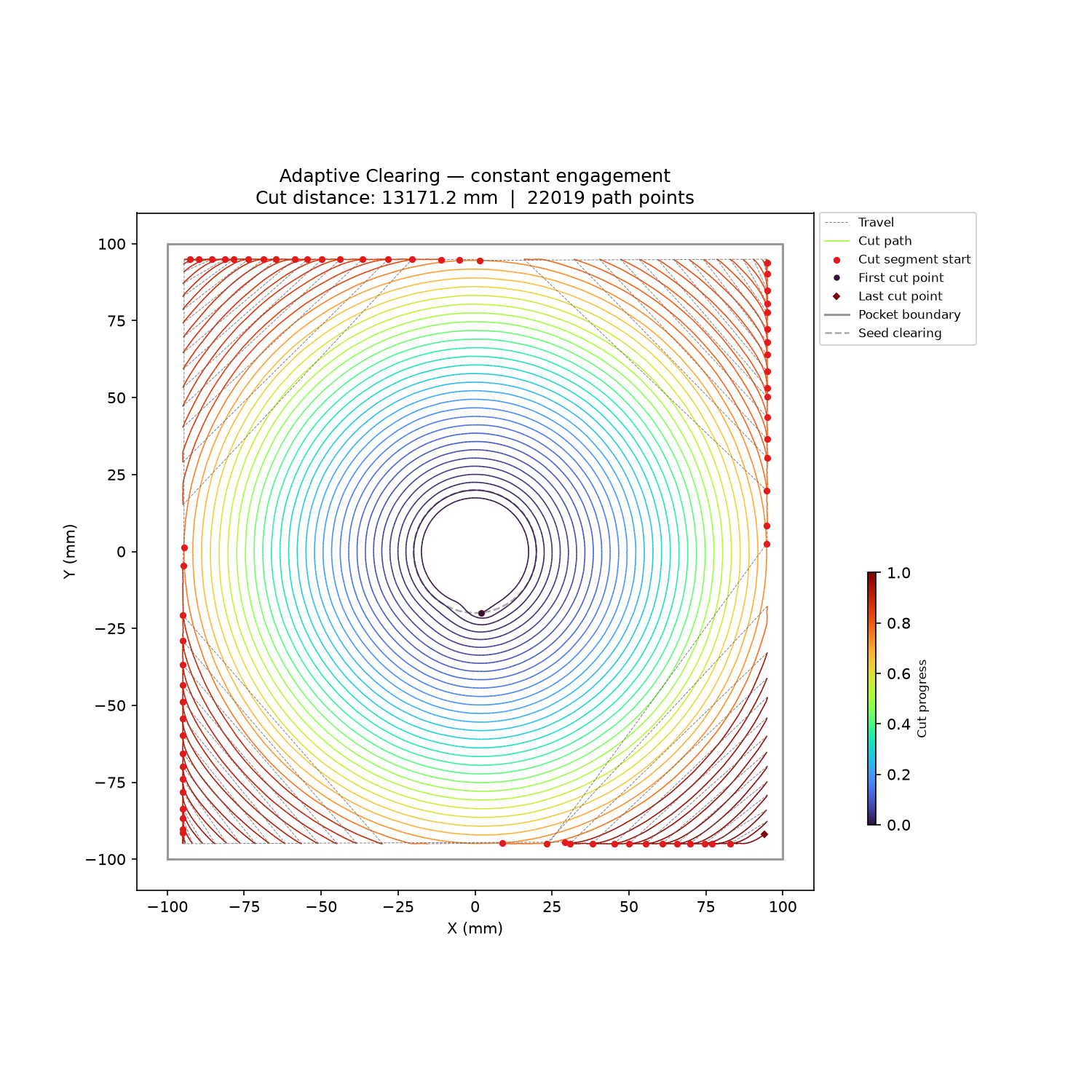
Constant-engagement clearing cuts, MAT-routed travel links, coloured by progress.
target_area_per_distance()
target_area_per_distance(
    radius: float,
    advance: float,
    step_length: float,
) -> float
Target cut-area per unit distance for the engagement solver.
| Parameter | Type | Description |
|---|---|---|
radius | float | Tool radius in mm. |
advance | float | Step-over distance in mm. |
step_length | float | Forward step length in mm. |
| Returns | float | Target area per distance (mm). |
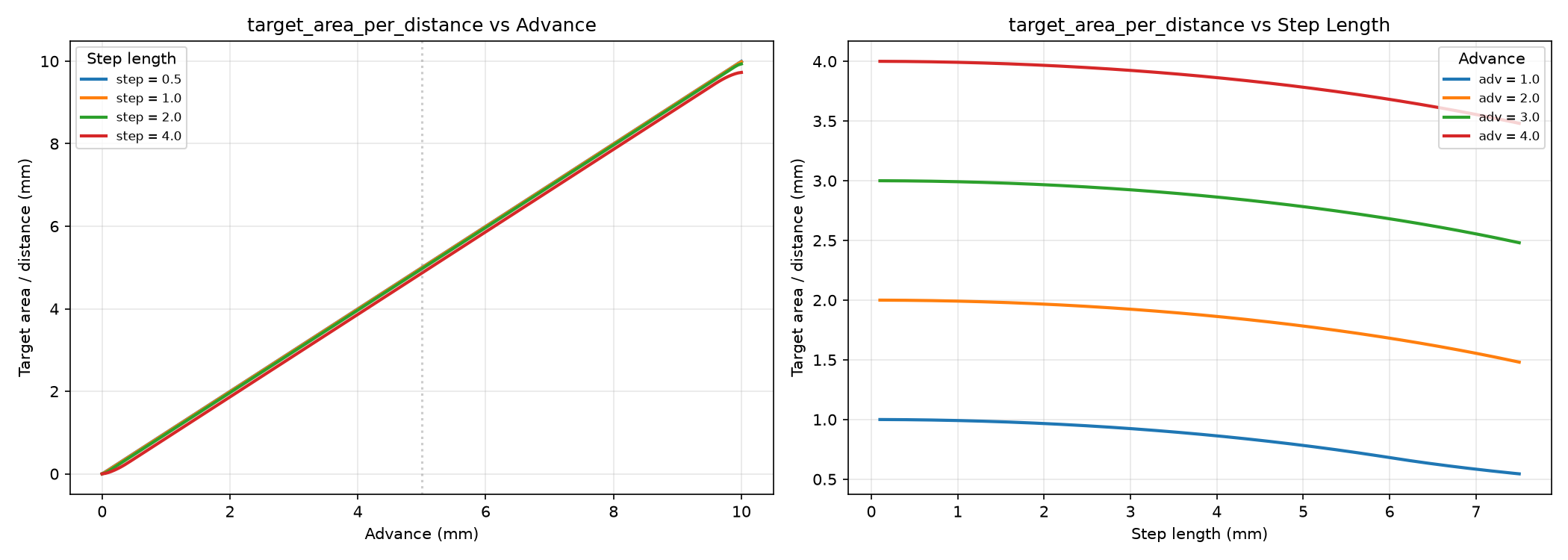
Left: area/distance vs advance for several step lengths. Right: vs step length for several advances.
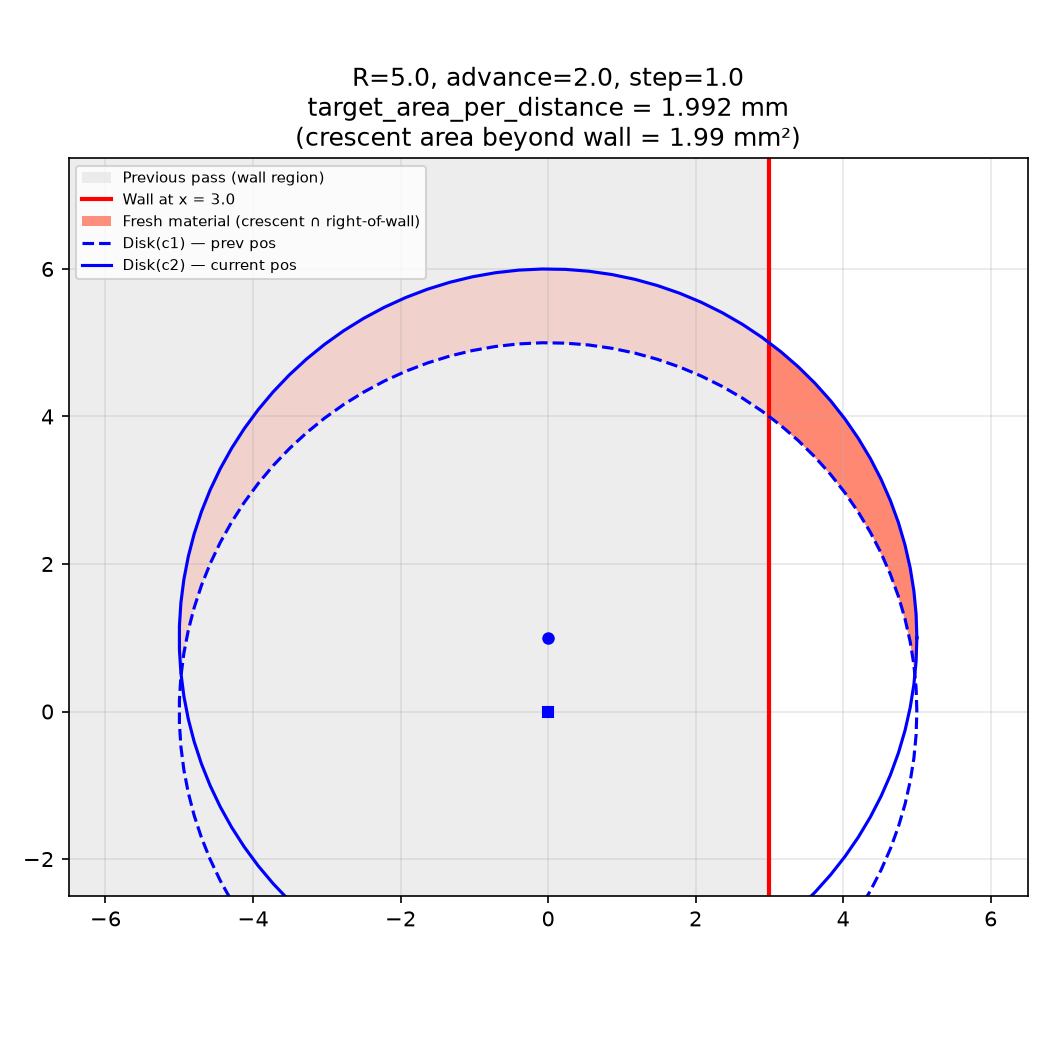
Two offset disks and a wall at x=R−advance: crescent beyond wall is fresh material.