


raygeo.geo.algo.medial_axis
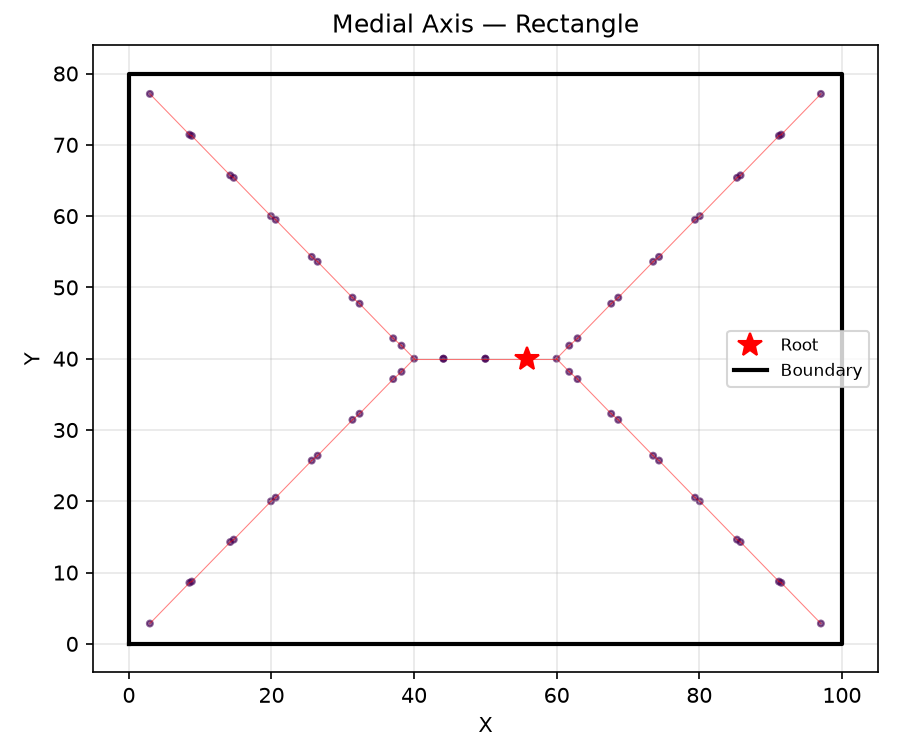
Medial axis of a rectangular pocket — skeleton from center to corners. Medial Axis Transform (MAT) computation.
The MAT is the skeleton of a 2D domain — the set of points equidistant to two or more boundary features. It is computed via Delaunay-get_circumcenter extraction from a constrained triangulation of the domain boundary.
MedialAxis.compute— compute the MAT of a domain (with optional holes).MedialAxis.path_between— find a path between two points along the skeleton.MedialAxis.trim_to_polygons— filter nodes to those inside given polygons.
MedialAxis
Medial Axis Transform of a planar domain.
The MAT is the set of points equidistant to two or more boundary features, forming the skeleton of the free space.
Usage:
axis = MedialAxis.compute(outer, holes)
path = axis.path_between((x1, y1), (x2, y2))
trimmed = axis.trim_to_polygons(polygons)
nodes = axis.nodes
clearances = axis.clearances
edges = axis.edges
root = axis.root
branches = axis.branches
branches
branches: list[list[int]]
clearances
clearances: list[float]
edges
edges: list[tuple[int, int]]
nodes
nodes: list[tuple[float, float]]
root
root: int
compute()
compute(
    outer: Sequence[tuple[float, float]],
    holes: Optional[Sequence[Sequence[tuple[float, float]]]] = None,
    min_clearance: float = 1.0,
    sampling_spacing: float = 1.0,
) -> MedialAxis
Compute the Medial Axis Transform of a planar domain.
| Parameter | Type | Description |
|---|---|---|
outer | Sequence[tuple[float, float]] | Outer boundary polygon (list of (x, y) vertices). |
holes | Optional[Sequence[Sequence[tuple[float, float]]]] = None | List of hole polygons (each a list of (x, y) vertices). |
min_clearance | float = 1.0 | Minimum clearance distance in mm. |
sampling_spacing | float = 1.0 | Spacing between sampling points in mm. |
| Returns | MedialAxis | MedialAxis object. |
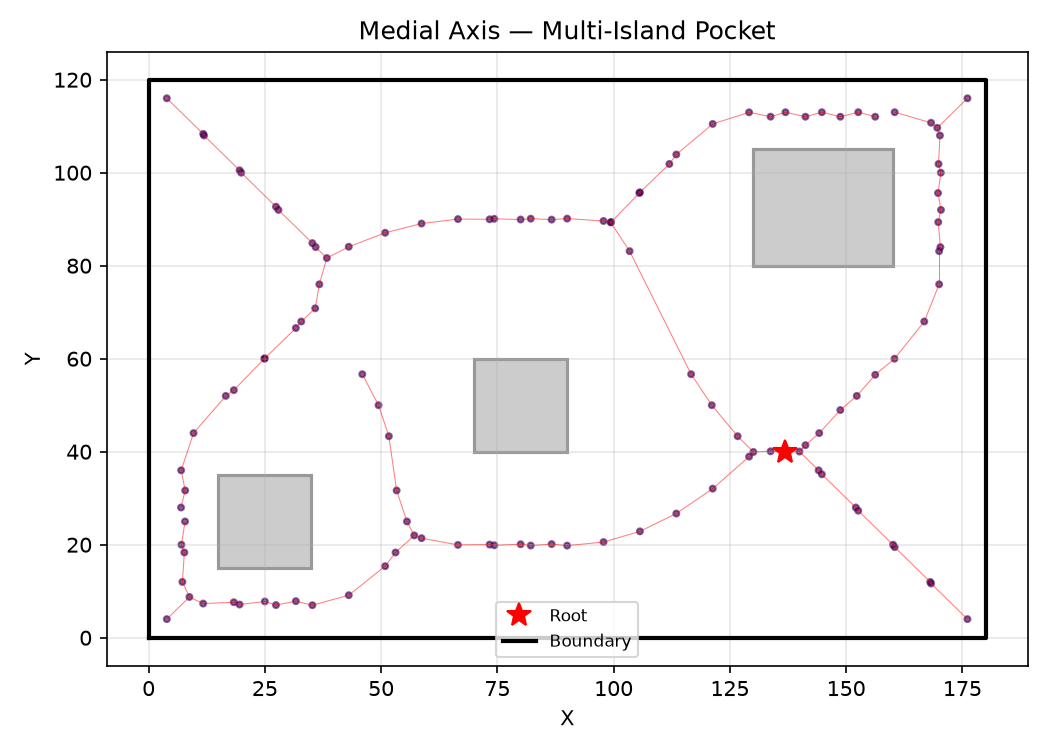
Medial axis with three rectangular islands — skeleton branches around each obstacle.
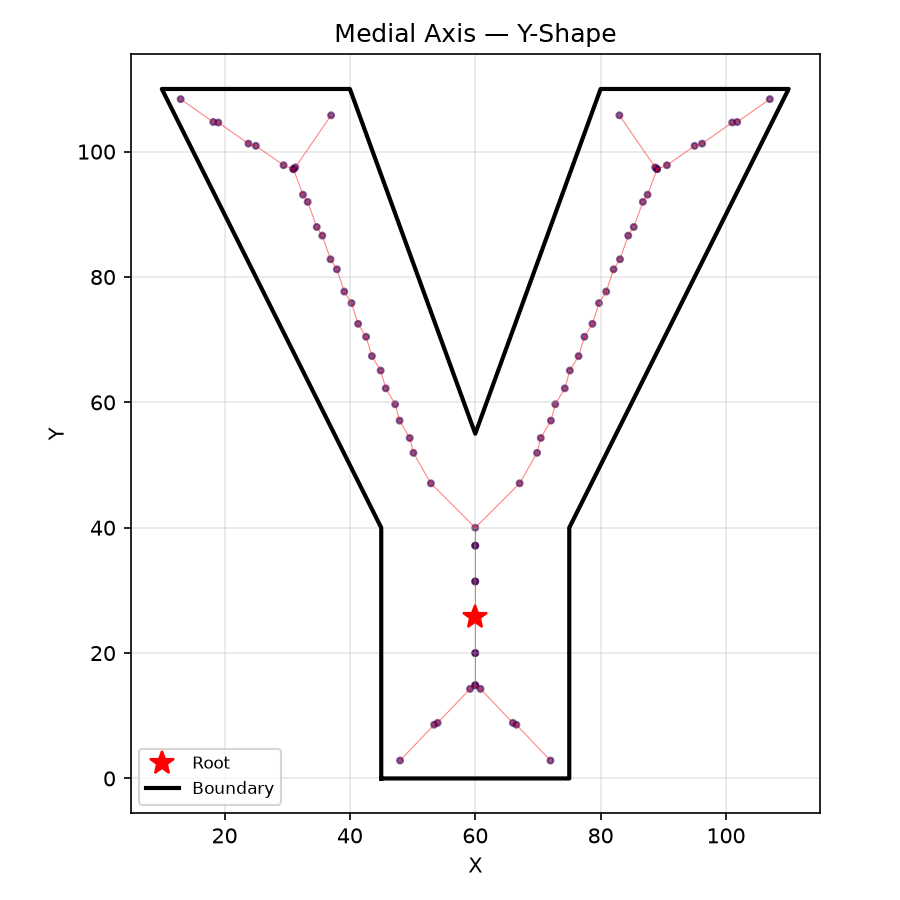
Medial axis of a Y-shaped channel — skeleton follows the branching topology.
path_between()
path_between(
    from_pt: tuple[float, float],
    to_pt: tuple[float, float],
) -> Optional[list[tuple[float, float]]]
Find a path between two points along the medial axis skeleton.
| Parameter | Type | Description |
|---|---|---|
from_pt | tuple[float, float] | Start point (x, y). |
to_pt | tuple[float, float] | End point (x, y). |
| Returns | Optional[list[tuple[float, float]]] | List of (x, y) waypoints along the medial axis. |
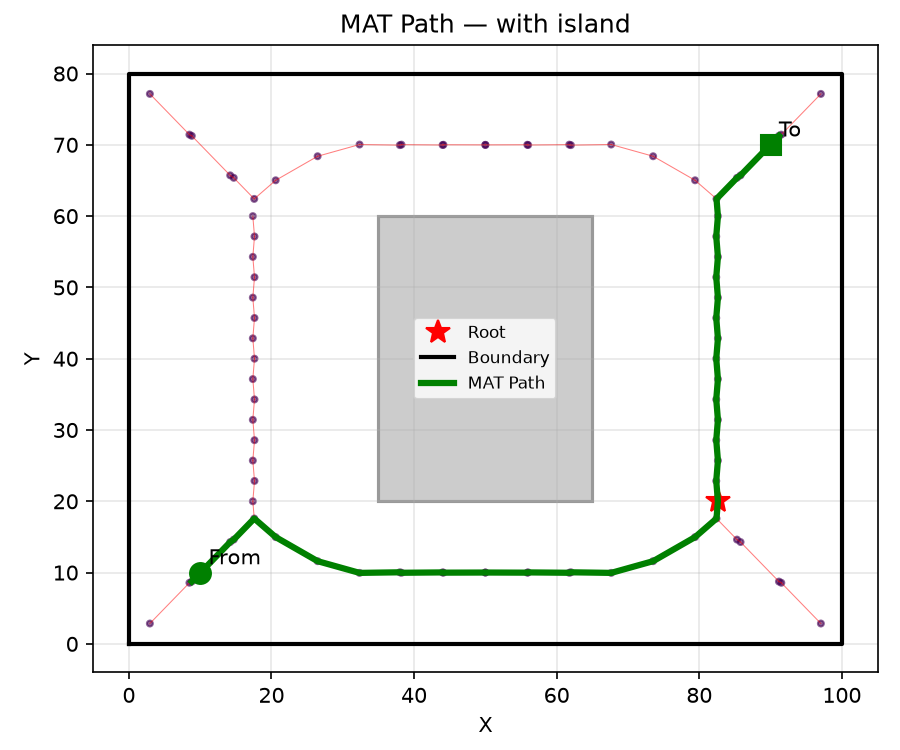
MAT path routing: a path between two points along the medial axis skeleton, avoiding the island
trim_to_polygons()
trim_to_polygons(
    polygons: Sequence[Sequence[tuple[float, float]]],
) -> MedialAxis
Return a new MedialAxis containing only nodes whose positions fall inside at least one of the
given polygons.
| Parameter | Type | Description |
|---|---|---|
polygons | Sequence[Sequence[tuple[float, float]]] | List of polygons to trim against. |
| Returns | MedialAxis | Trimmed MedialAxis. |
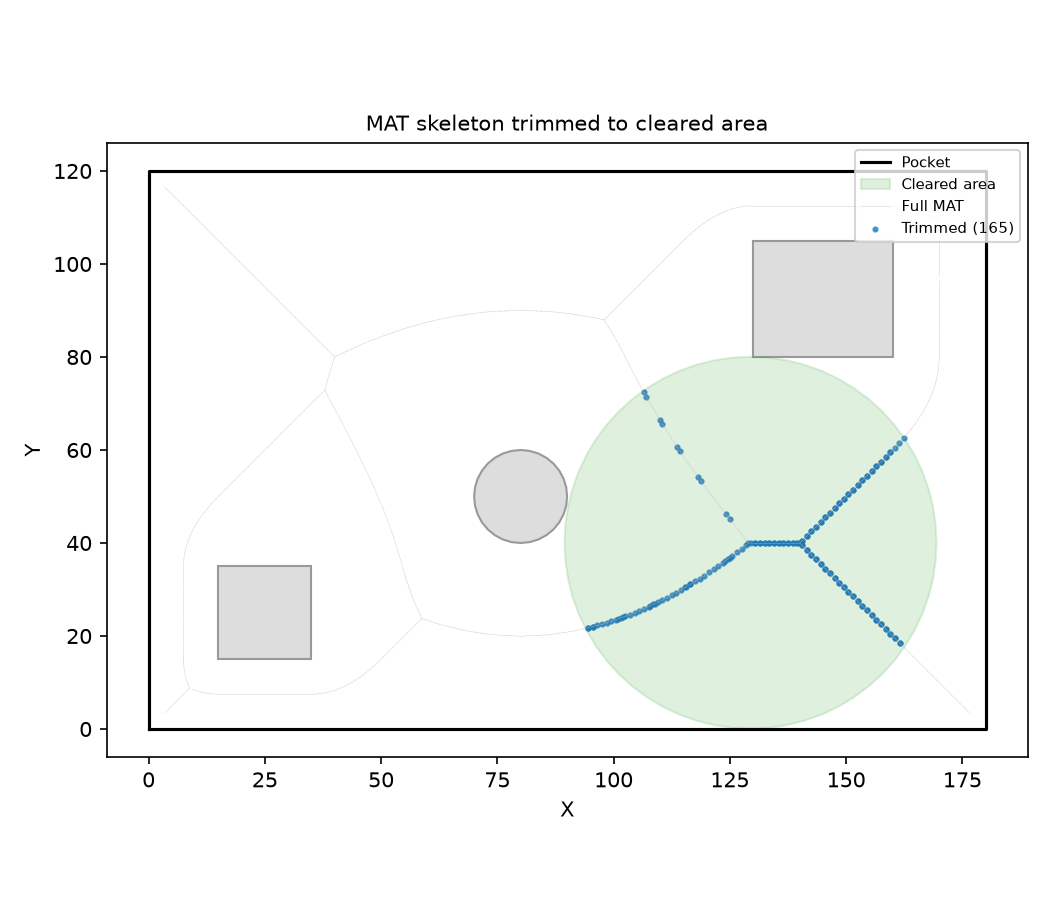
MAT trimmed to cleared area: original (gray) and trimmed nodes (blue) after multiple clearing passes