


raygeo.geo.algo.cylindrical
Functions
transform_to_cylinder()
transform_to_cylinder(
    verts: numpy.NDArray[numpy.float32],
    diameter: float,
    colors: numpy.NDArray[numpy.float32] | None = None,
    degrees_input: bool = False,
    radial_offset: float = 0,
) -> tuple[numpy.NDArray[numpy.float32], numpy.NDArray[numpy.float32] | None, numpy.NDArray[numpy.int32]]
Transform flat vertex pairs to cylindrical coordinates.
The input has angular values on axis 1 (Y) and linear position on axis 0 (X). The output maps to:
X = linear position along cylinder
Y = r * sin(theta)
Z = r * cos(theta)
Line segments are subdivided as needed to follow the cylinder surface instead of cutting through the interior.
| Parameter | Type | Description |
|---|---|---|
verts | numpy.NDArray[numpy.float32] | Float32 array of shape (N, 3) with X, Y, Z per vertex. Vertices are in pairs (line segments for GL_LINES). |
diameter | float | Cylinder diameter in mm. |
colors | numpy.NDArray[numpy.float32] | None = None | Optional float32 array of shape (N, 4) RGBA colors. |
degrees_input | bool = False | If True, Y values are in degrees and converted directly. If False (default), they are in motor units (mu) and converted via mu_to_degrees. |
radial_offset | float = 0 | Outward radial offset (mm) applied to every vertex. Used to lift overlay lines off the cylinder surface to avoid Z-fighting. |
| Returns | tuple[numpy.NDArray[numpy.float32], numpy.NDArray[numpy.float32] | None, numpy.NDArray[numpy.int32]] | Tuple of (transformed_vertices, expanded_colors, cum_subs). cum_subs is a cumulative subdivision count array. |
| Complexity | O(N * subdivisions) |
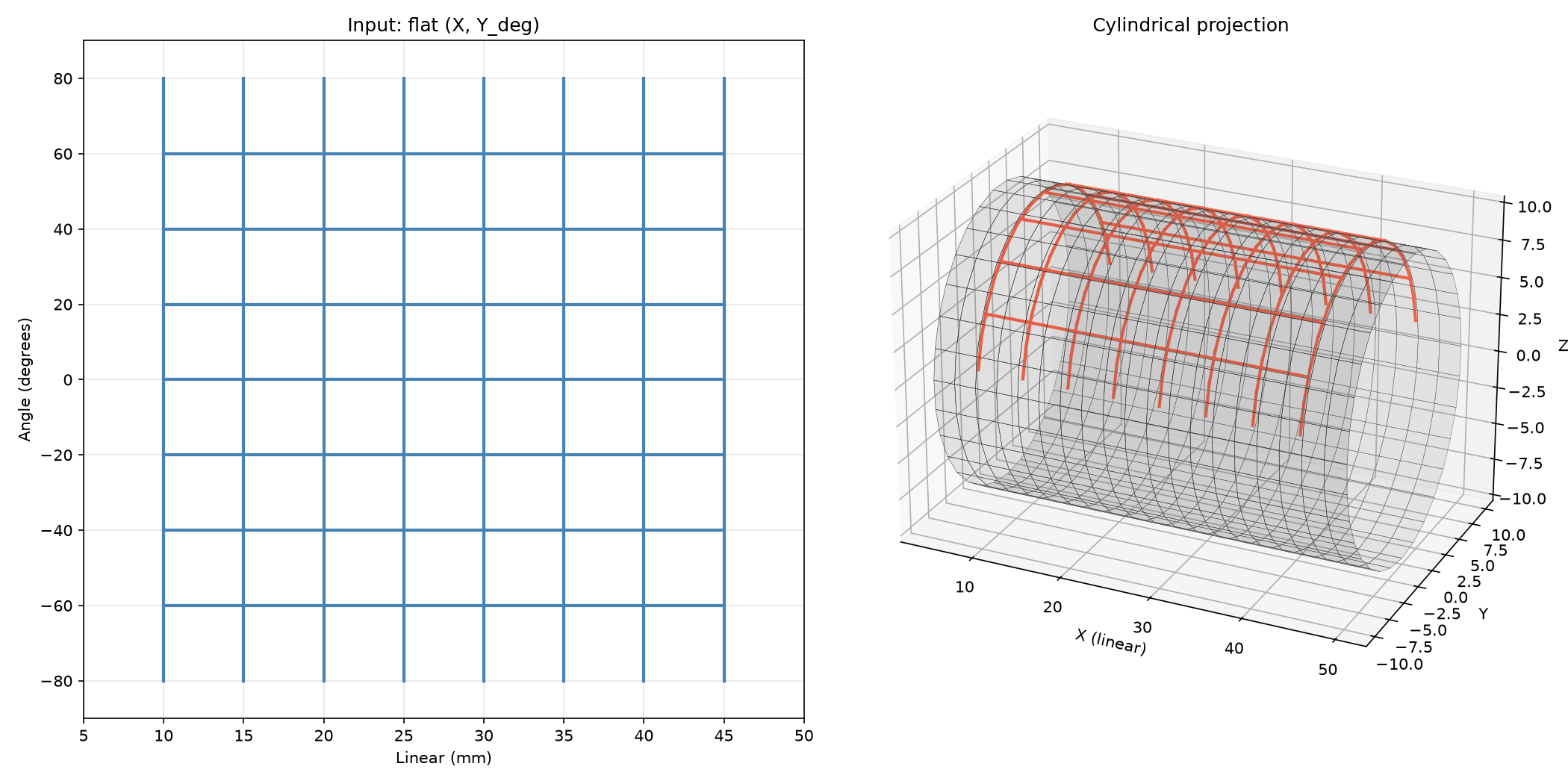
Flat vertex pairs wrapped onto a cylinder surface