


raygeo.geo.algo.cleared_area
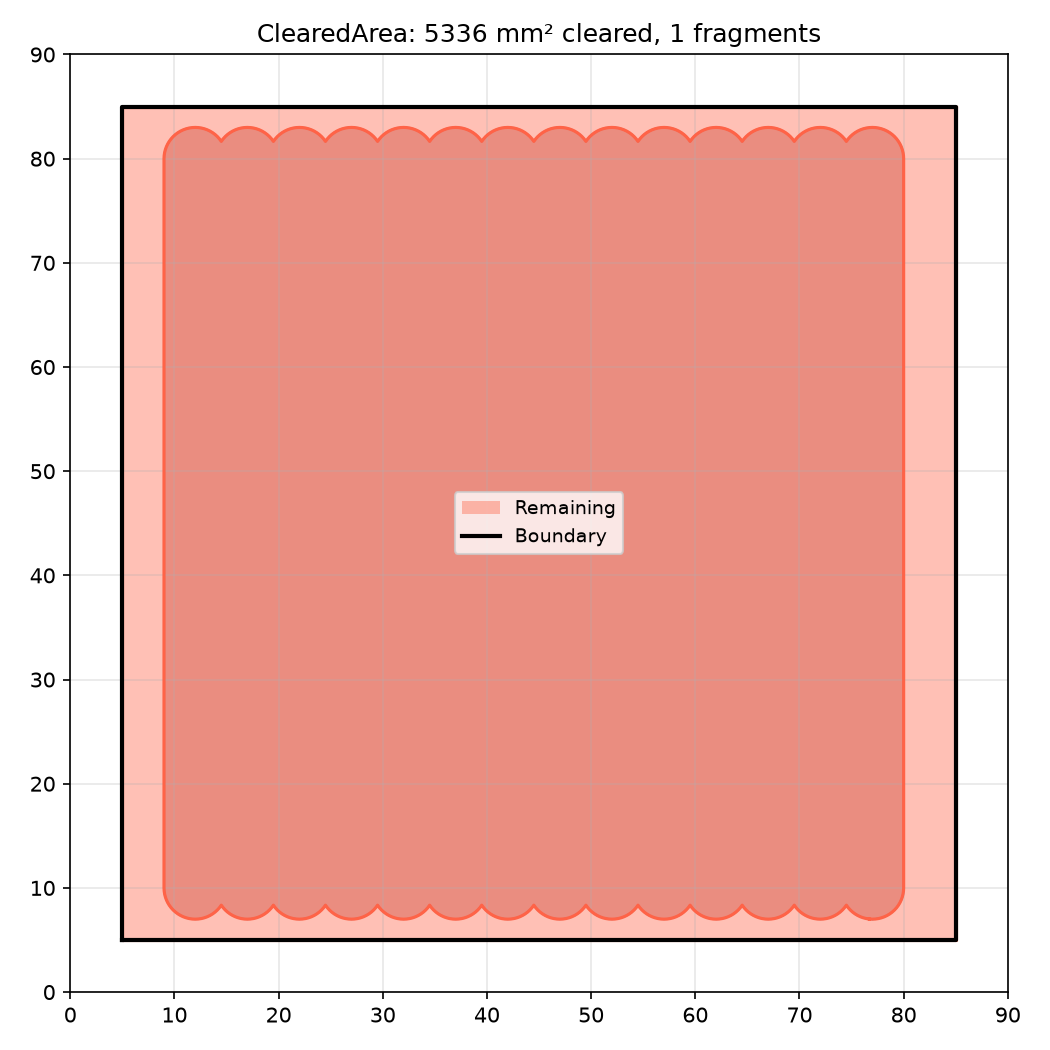
ClearedArea tracking a simulated raster toolpath — cleared fragments shown in blue, remaining area in red Incremental cleared-area tracker for adaptive clearing.
Maintains a union of tool-swept polygons and provides a spatial-indexed windowed query for efficient engagement computation.
ClearedArea
add_cleared_polygons()
add_cleared_polygons(polygons: Sequence[Sequence[tuple[float, float]]]) -> None
| Parameter | Type | Description |
|---|---|---|
polygons | Sequence[Sequence[tuple[float, float]]] | |
| Returns | None | |
| Complexity | O(n) where n = total vertices across all polygons |
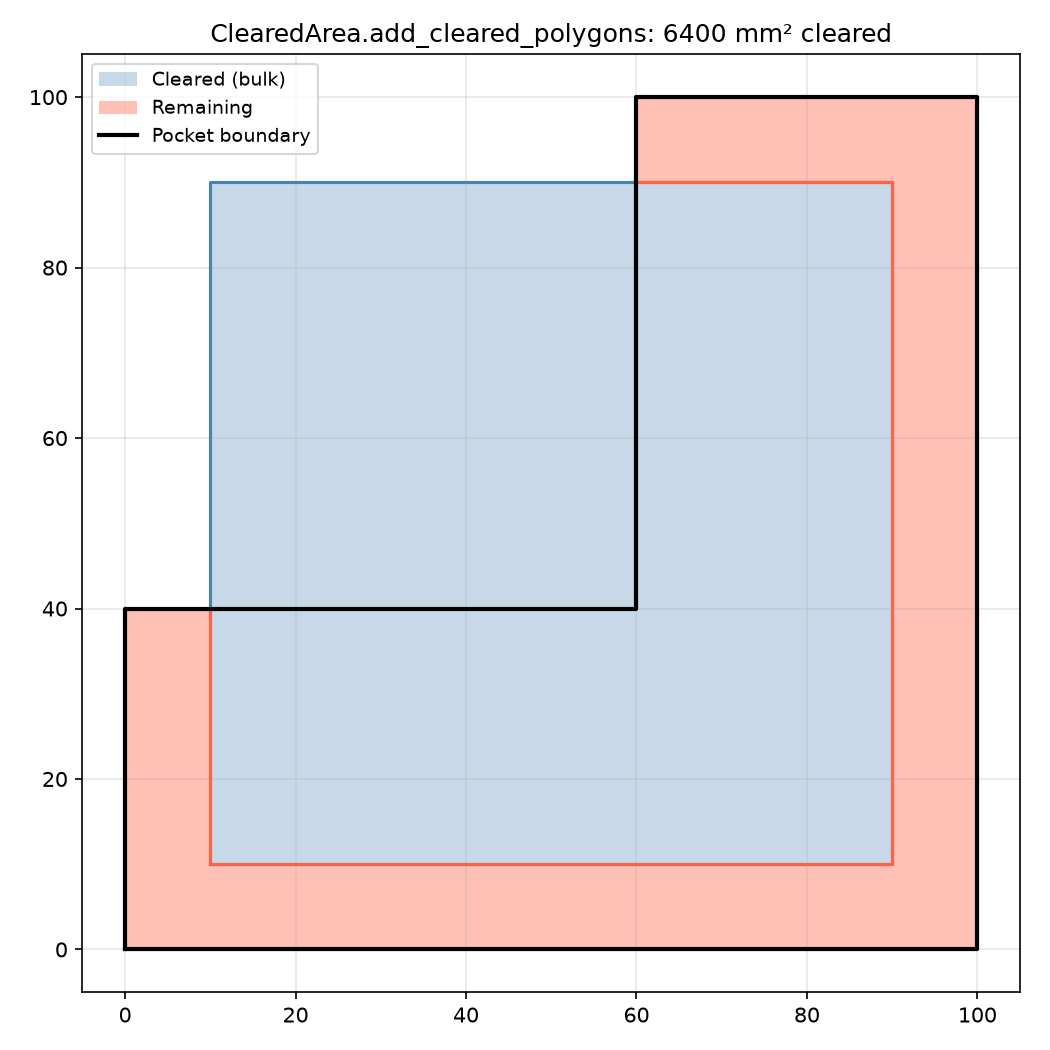
ClearedArea with bulk polygon insertion via add_cleared_polygons — cleared region in blue,
remaining area in red
bite_in_direction()
bite_in_direction(
    step_over: float,
    valid_area: Sequence[Sequence[tuple[float, float]]],
    simplify_tol: float,
    target: tuple[float, float],
    max_angle: float,
) -> list[list[tuple[float, float]]]
Like bites but filters to only the bites whose centroid lies within max_angle radians of the direction from the current cleared region's centre toward target. useful for steering the clearing direction along a MAT branch.
| Parameter | Type | Description |
|---|---|---|
step_over | float | lateral step-over in mm |
valid_area | Sequence[Sequence[tuple[float, float]]] | list of polygons defining the valid tool-centre region |
simplify_tol | float | tolerance in mm for frontier simplification |
target | tuple[float, float] | (x, y) target point to steer toward |
max_angle | float | maximum deviation from the target direction (radians) |
| Returns | list[list[tuple[float, float]]] | |
| Complexity | O(n log n) |
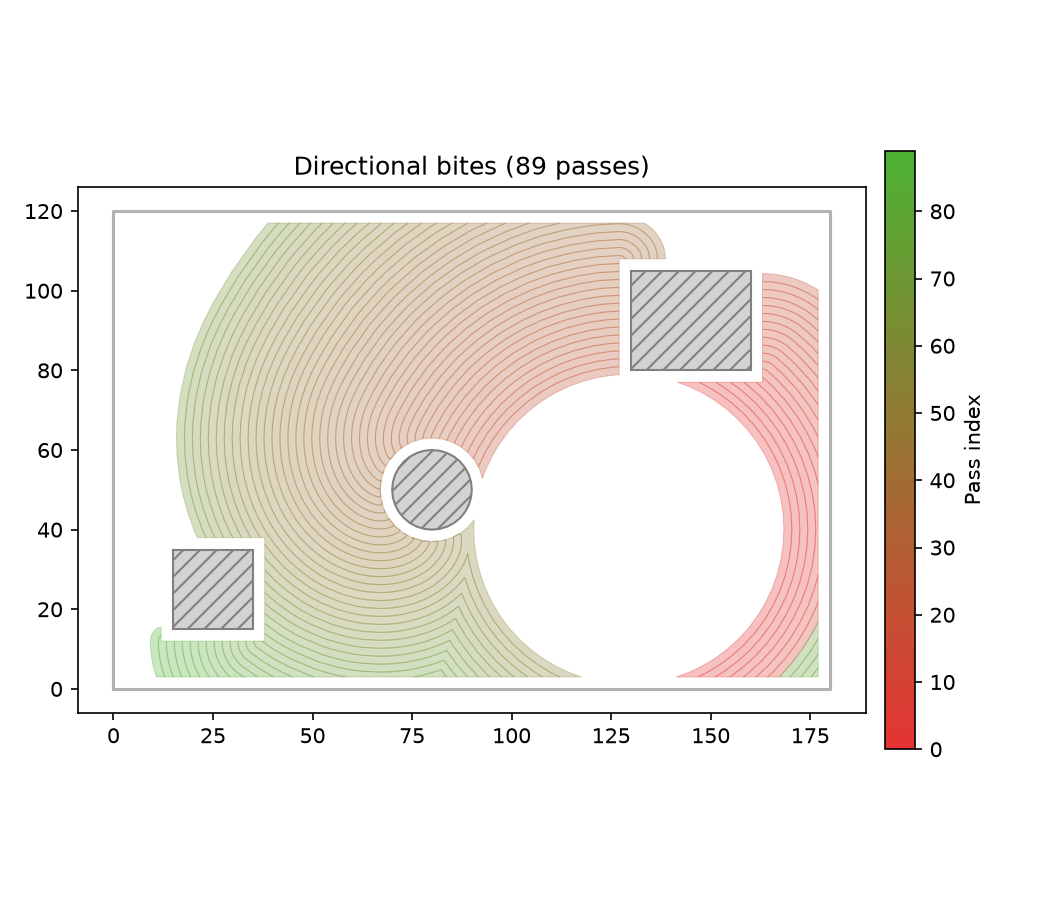
Directional bites coloured by pass order (first = dark, later = pale)
bites()
bites(
    step_over: float,
    valid_area: Sequence[Sequence[tuple[float, float]]],
    simplify_tol: float,
) -> list[list[tuple[float, float]]]
Compute the "bites" — new material reachable by expanding the current frontier outward by step_over, clipping to valid_area, and subtracting already-cleared portions.
| Parameter | Type | Description |
|---|---|---|
step_over | float | lateral step-over in mm |
valid_area | Sequence[Sequence[tuple[float, float]]] | list of polygons defining the valid tool-centre region |
simplify_tol | float | tolerance in mm for frontier simplification |
| Returns | list[list[tuple[float, float]]] | |
| Complexity | O(n log n) |
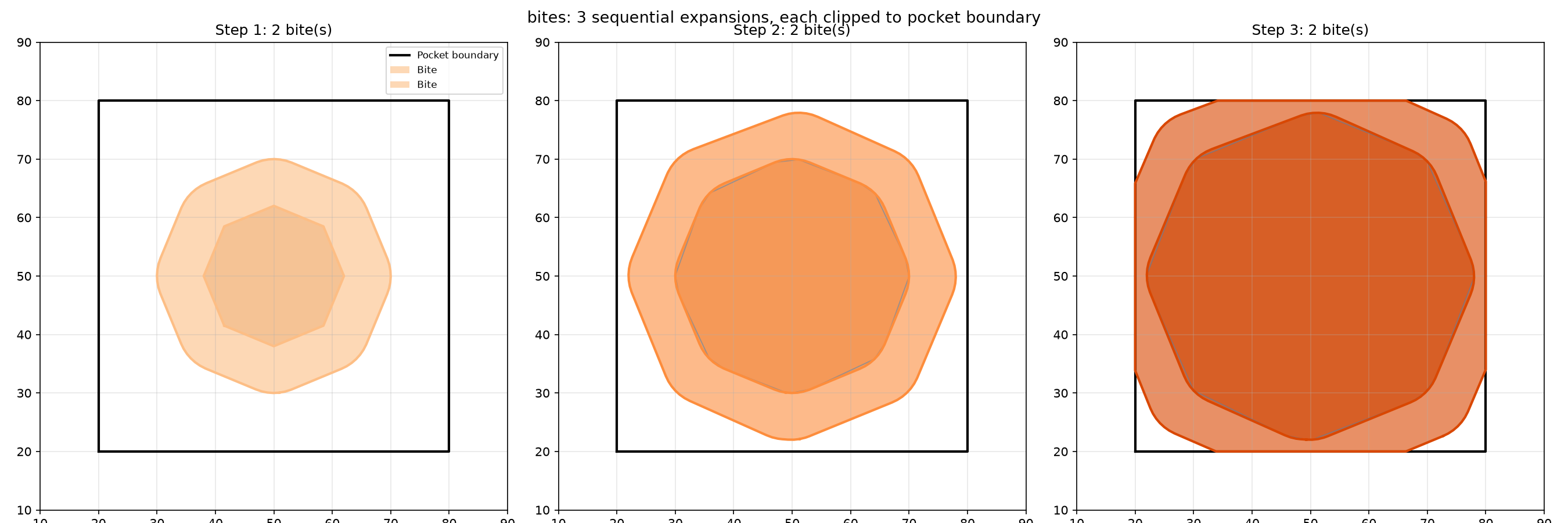
bites computes the expansible material — the crescent-shaped regions of uncut material reachable
by expanding the frontier by step_over.
expand()
expand(tool_path: Sequence[tuple[float, float]], tool_radius: float) -> None
| Parameter | Type | Description |
|---|---|---|
tool_path | Sequence[tuple[float, float]] | |
tool_radius | float | |
| Returns | None | |
| Complexity | O(n) where n = number of path points |
fragments()
fragments() -> list[list[tuple[float, float]]]
Return the union of all polygons currently tracked as cleared.
Each fragment is a closed polygon (list of (x, y) vertices) representing an area that has already
been cut. The fragment set grows as incorporate or add_cleared_polygons are called.
This is useful for determining which parts of a bite polygon lie outside the cleared area (i.e. the cutting arc), for example when used with raygeo.ops.assembly.hsm.find_cutting_arc.
| Parameter | Type | Description |
|---|---|---|
| Returns | list[list[tuple[float, float]]] | |
| Complexity | O(m) where m = number of fragments |
frontier()
frontier(simplify_tol: float) -> list[list[tuple[float, float]]]
Return a unioned, simplified snapshot of the current outer boundary.
| Parameter | Type | Description |
|---|---|---|
simplify_tol | float | tolerance in mm for polyline simplification |
| Returns | list[list[tuple[float, float]]] | |
| Complexity | O(n log n) |
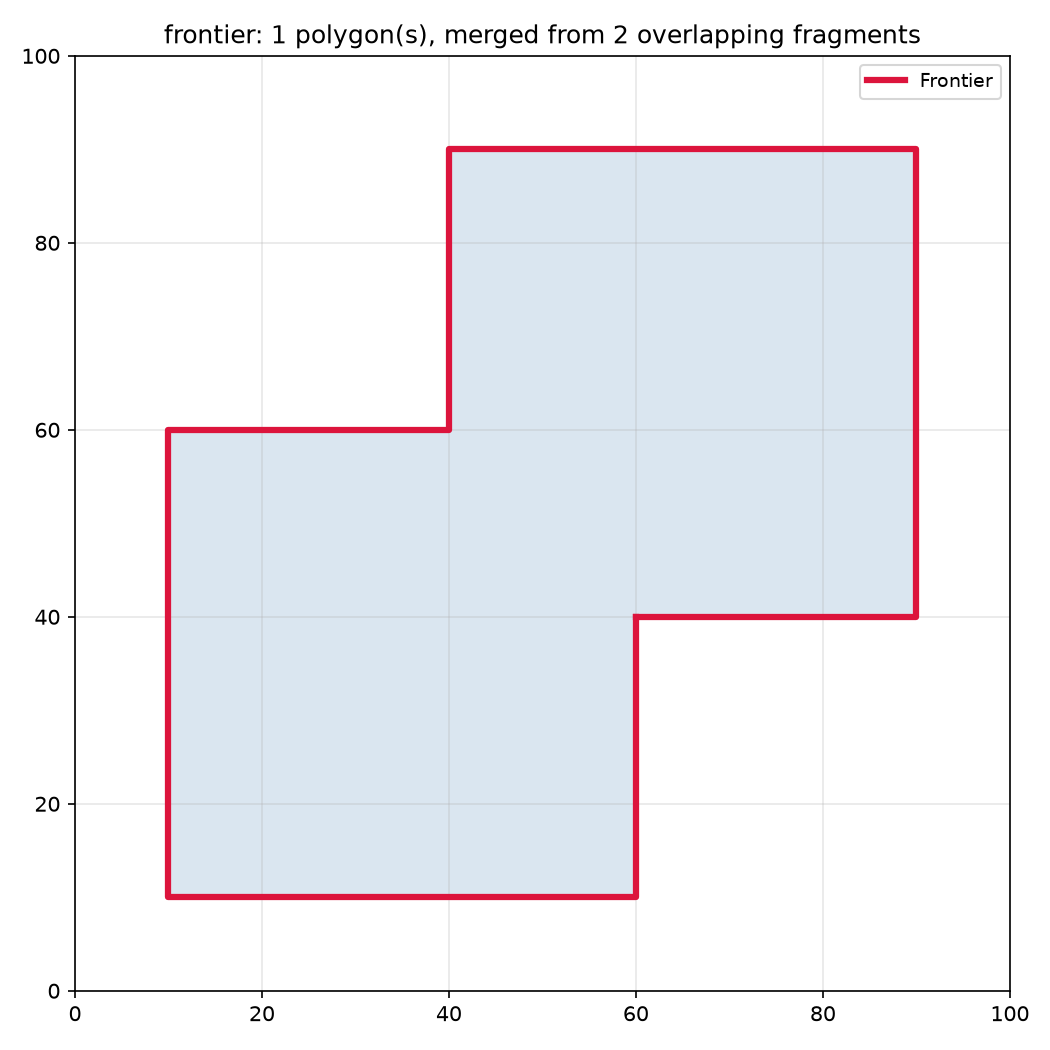
frontier returns the outer boundary of the cleared area after merging overlapping fragments —
shown in crimson.
incorporate()
incorporate(
    polygons: Sequence[Sequence[tuple[float, float]]],
) -> list[list[tuple[float, float]]]
Add polygons, returning only the newly-added portion. Faster than add_cleared_polygons when inputs don't overlap existing fragments (skips the full union). O(n) when inputs are disjoint from existing fragments
| Parameter | Type | Description |
|---|---|---|
polygons | Sequence[Sequence[tuple[float, float]]] | |
| Returns | list[list[tuple[float, float]]] | |
| Complexity | O(n log n) worst case when union required, |
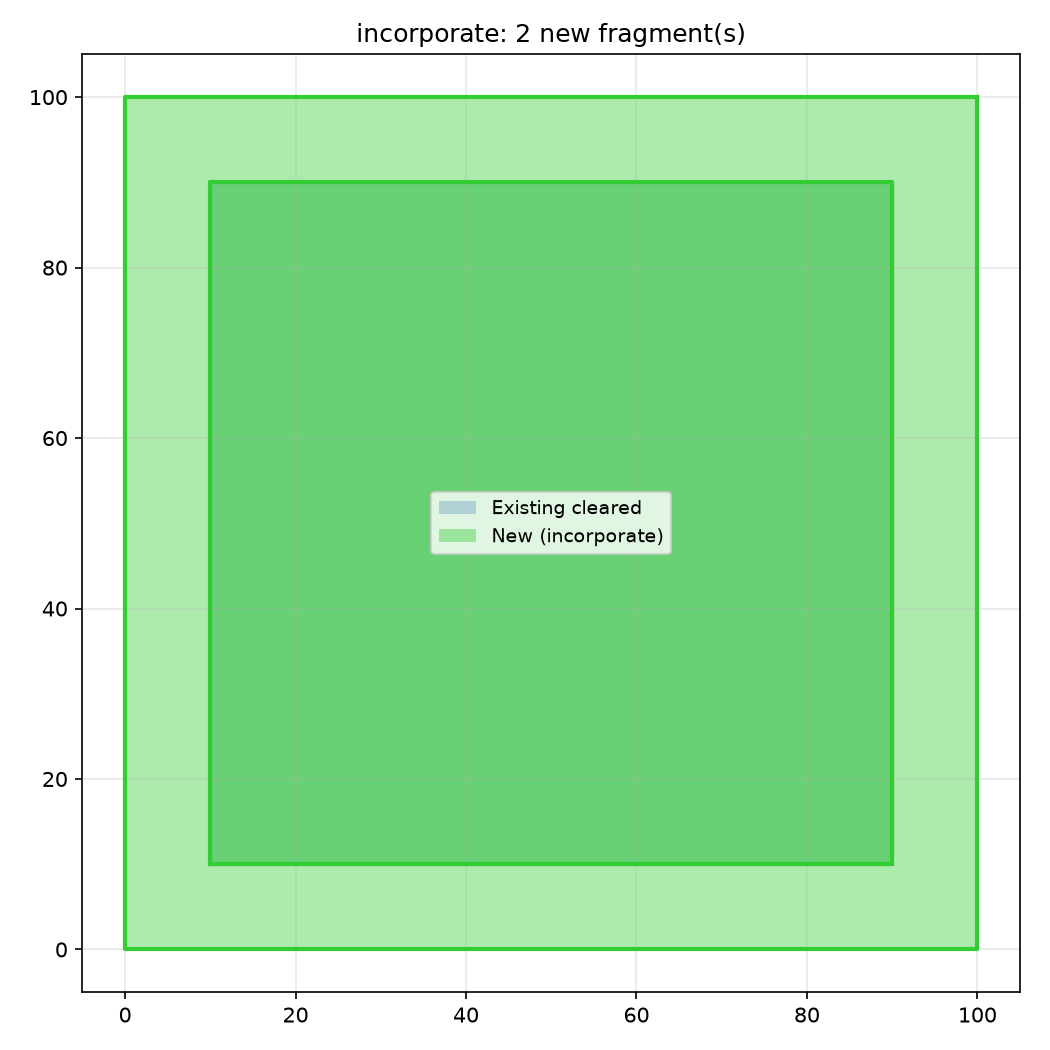
incorporate adds polygons to the cleared state while returning only the newly-covered region
(shown in green).
query_window()
query_window(
    bbox: tuple[float, float, float, float],
) -> list[list[tuple[float, float]]]
| Parameter | Type | Description |
|---|---|---|
bbox | tuple[float, float, float, float] | |
| Returns | list[list[tuple[float, float]]] | |
| Complexity | O(m + k) where m = number of fragments, k = output vertices |
remaining()
remaining(
    bounds: Sequence[Sequence[tuple[float, float]]],
) -> list[list[tuple[float, float]]]
| Parameter | Type | Description |
|---|---|---|
bounds | Sequence[Sequence[tuple[float, float]]] | |
| Returns | list[list[tuple[float, float]]] | |
| Complexity | O(n * m) where n = bounds vertices, m = fragments |
remaining_in_inset()
remaining_in_inset(
    boundary: Sequence[tuple[float, float]],
    obstacles: Optional[Sequence[Sequence[tuple[float, float]]]] = None,
    radius: float = 3.0,
) -> list[list[tuple[float, float]]]
Compute the inset region of boundary by radius (excluding obstacles), then return the portions of that region not covered by stored fragments, together with the original obstacle polygons.
| Parameter | Type | Description |
|---|---|---|
boundary | Sequence[tuple[float, float]] | Outer boundary polygon. |
obstacles | Optional[Sequence[Sequence[tuple[float, float]]]] = None | Obstacle (hole) polygons to exclude. |
radius | float = 3.0 | Inset distance applied to boundary and obstacles. |
| Returns | list[list[tuple[float, float]]] | List of polygons — the obstacles plus the uncovered portion of the inset region. |
| Complexity | O(n log n) for the inset and difference operations. |
total_area()
total_area() -> float
| Parameter | Type | Description |
|---|---|---|
| Returns | float | |
| Complexity | O(1) |